Green Lens AI: Rewrites Your Items. You Decide.
Green Lens AI helps test writers revise stems and distractors with transparent, item-level suggestions. Review what changed, understand why, and accept, reject, or edit each revision with full control.

Green Lens AI: Rewrites Your Items. You Decide.
Writing test items takes time. Revising them takes even more.
A stem may be slightly unclear. A distractor may be too easy to eliminate. An option may sound unnatural, vague, or too close to the correct answer. Sometimes the issue is small, but finding it across an entire test is still slow, repetitive work.
Green Lens AI is built for that exact moment.
You upload your test, and Green Lens AI reviews each item one by one. It analyzes the stem and the distractors, suggests revisions, and clearly shows what changed and why. But it does not take control away from the test writer. Every suggestion can be accepted, rejected, or edited.
That is the idea behind the feature:
AI rewrites your items. You decide.
A smarter revision workflow
Most item review workflows are messy.
Teams often move between Word files, comments, spreadsheets, and back-and-forth discussions. Someone notices a weak distractor. Someone else rewrites the stem. A third reviewer is not sure what changed from the original version. Over time, revision becomes difficult to track.
Green Lens AI makes that process much clearer.
Instead of giving generic feedback, it presents revisions at the item level in a structured format. You can review the original wording, see the AI suggestion, and understand the logic behind the proposed change. This turns revision into a visible workflow rather than a guessing game.
What Green Lens AI shows
The feature is designed around practical review, not black-box output. The workflow is broken into four clear parts:
1. Item Header
At a glance, Green Lens AI surfaces key item-level context such as CEFR level, cognitive domain in Bloom’s Taxonomy, and health status.
This helps the reviewer understand not just the wording of the item, but its broader role in the test. Instead of reading an item in isolation, you can see where it sits instructionally and cognitively.
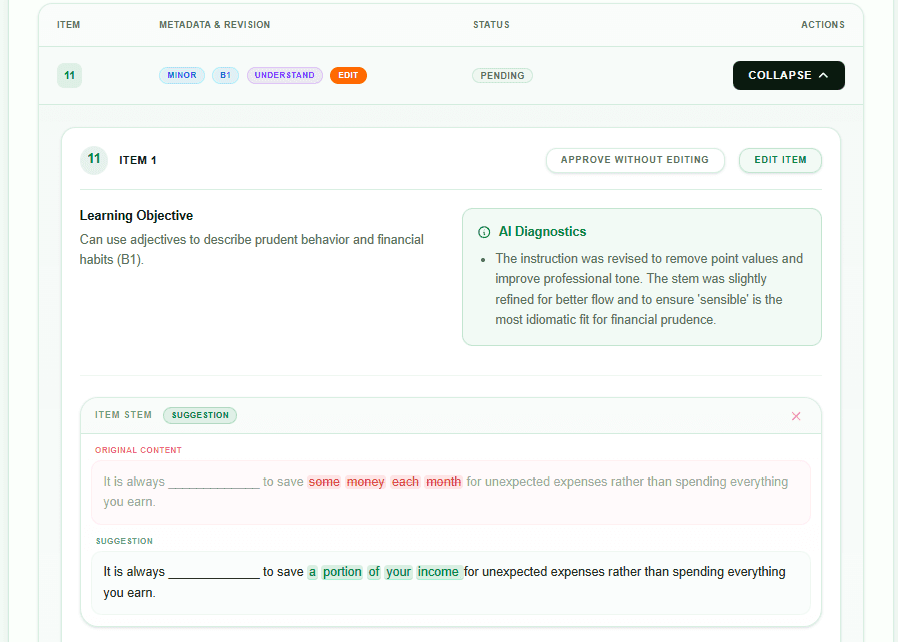
2. Stem Diff
Green Lens AI shows exactly what changed in the stem.
Rather than replacing the original silently, it highlights revisions word by word. That matters because test writers do not just want a new version. They want to know:
- what was changed
- how much was changed
- whether the change improves precision
- whether the original intent is still preserved
This diff-based view makes the editing process much more transparent.
3. Option Revisions
Each distractor is analyzed separately.
That is important because weak multiple-choice items often fail at the option level, not just the stem level. A distractor may be implausible, too obvious, grammatically inconsistent, or misleading in the wrong way. Green Lens AI reviews each option and lets the user accept or reject changes one by one.
That means the user is not forced into an all-or-nothing rewrite. You can keep what works, reject what does not, and improve only the parts that need attention.
4. AI Diagnostics
Green Lens AI also explains the reasoning behind its suggestions.
The goal is not just to rewrite items, but to make revision more understandable. If a proper noun needs quotation marks, if a distractor is too close to a real-world fact, or if the key is too vague, the system can surface that logic as part of the review flow.
This makes the feature more useful for both experienced item writers and teams that want more structured support.
Full control, zero guesswork
This is the most important part of Green Lens AI.
It is not built to replace item writers. It is built to help them work faster and more confidently.
Many AI tools generate polished-looking output but give the user very little visibility into what happened. That is not ideal in assessment settings, where wording decisions can affect validity, fairness, and interpretation.
Green Lens AI takes a different approach. It keeps the human reviewer in the loop at every step:
- review the original version
- inspect the suggested revision
- see what changed
- understand why it changed
- accept, reject, or edit the suggestion
That creates a workflow with much more control and much less uncertainty.
Why this matters for assessment teams
In real assessment work, revision quality matters just as much as revision speed.
A faster workflow is useful, but only if it still supports professional judgment. Test writers need to be able to trust what they are seeing, challenge suggestions when needed, and preserve the intent of the original item.
Green Lens AI supports exactly that balance.
It helps reduce the time spent on repetitive editing while still leaving the final decision with the person who knows the test, the learners, and the target construct best.
For teams working under deadline, this can make a major difference. Instead of manually scanning every item for wording issues, they can move into a more focused review mode where attention goes to the places that matter most.
More than rewriting
At first glance, Green Lens AI may look like an item rewriting tool. But the real value is deeper than that.
It creates a more transparent revision process.
It helps teams move from vague feedback like “this item feels off” to something much more concrete:
- here is the original wording
- here is the revision
- here is the difference
- here is the reason
- here is your choice
That kind of clarity is useful not only for improving items, but also for building shared review standards within a team.
Human judgment stays at the center
Assessment is too important for blind automation.
That is why Green Lens AI is designed around assisted revision, not automatic replacement. The system supports the writer, but the writer remains responsible for the final form of the item.
That is the promise behind the feature and the line that defines it best:
AI rewrites your items. You decide.